




The recent shooting at the Teotihuacán pyramids in Mexico, which resulted in the death of a Canadian tourist and multiple injuries, serves as a stark reminder that the global threat environment is becoming increasingly unpredictable and interconnected. What was once often viewed as a localized security concern is now part of a much broader international risk landscape where ideologically driven violence, organized crime, civil unrest, and geopolitical instability are converging across borders. For organizations and individuals operating internationally, the assumption that certain destinations remain “low risk” is becoming increasingly difficult to justify.
Mexican authorities indicated that the Teotihuacán attack was premeditated, with the perpetrator reportedly in possession of materials linked to the Columbine High School massacre. This connection highlights the enduring global influence of American-origin mass casualty events and how the notoriety surrounding such attacks can continue to inspire lone-actor violence decades later. While firearm accessibility in the United States remains a major factor, the broader cultural normalization of mass casualty events—amplified through media exposure, online content, and extremist subcultures, has contributed to the spread of this threat model into countries like Canada and Mexico, where similar incidents, though historically less common, are becoming more frequent.
In Canada, there has been a noticeable rise in concerning rhetoric, lone-actor threats, and isolated violent incidents that mirror patterns commonly seen in the United States. Many of these individuals are radicalized or influenced through online ecosystems and often display clear pre-incident indicators such as fascination with past attacks, ideological grievances, or public and semi-public expressions of intent. The Teotihuacán incident reinforces the reality that these threat vectors are no longer confined by geography. Even environments traditionally considered lower risk are increasingly vulnerable to unpredictable acts of violence.
Mexico presents an especially complex threat environment where ideologically inspired violence intersects with longstanding cartel activity, organized crime, and trafficking networks. While the majority of cartel violence is not directed at tourists, the presence of criminal organizations creates an elevated baseline risk, particularly in regions where criminal competition is high or local enforcement capacity is limited. High-profile tourist destinations such as Teotihuacán also carry symbolic value, making them attractive targets for individuals seeking attention, notoriety, or broader impact. This creates layered security challenges for both leisure travelers and corporate travelers operating in the region.
More broadly, the incident reflects a global trajectory where risks and threats are increasing in both frequency and complexity. Ongoing geopolitical tensions involving the United States, adversarial states, the Middle East, Eastern Europe, and the rise of transnational ideological movements are contributing to a far more volatile operating environment. These factors influence not only state-level conflict, but also individual actors, protest movements, cyber threats, reputational risks, and operational disruptions for organizations with international exposure. Businesses are now required to think beyond traditional security planning and adopt a far more dynamic approach to risk management.
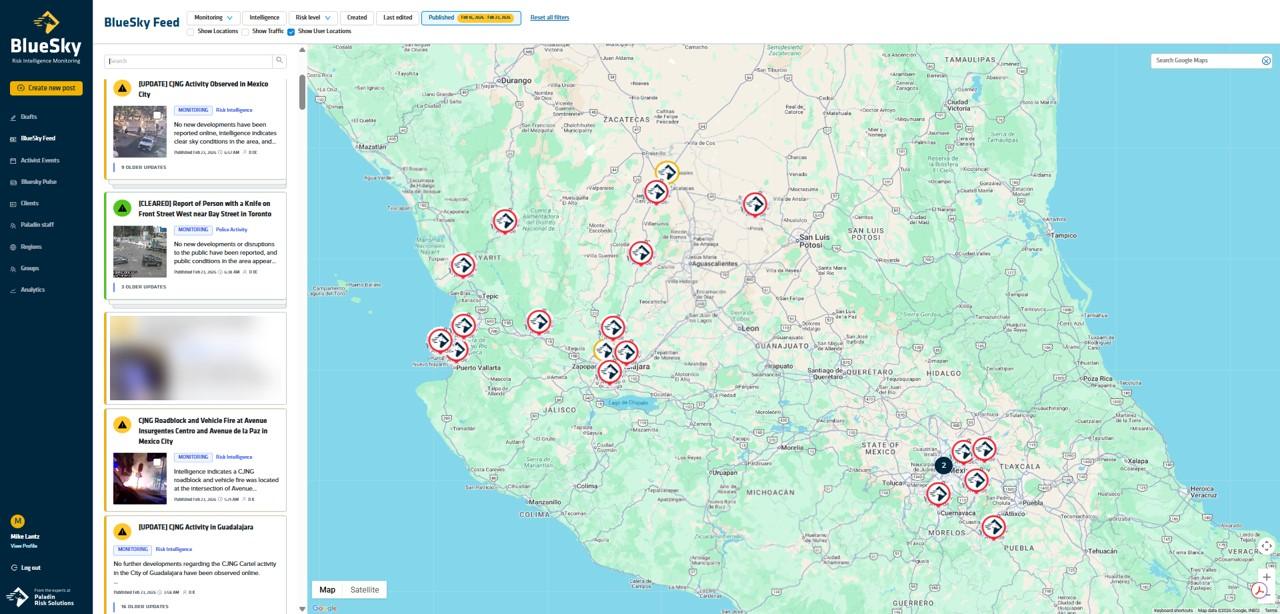
This is where proactive intelligence becomes essential. The BlueSky Travel program from Paladin Risk Solutions is designed to provide organizations and individuals with real-time, intelligence-led travel risk management that begins long before departure. This includes comprehensive pre-trip due diligence assessing destination-specific threats such as political instability, criminal activity, health concerns, environmental disruptions, and cultural considerations. During travel, clients receive continuous monitoring and real-time intelligence updates regarding civil unrest, criminal incidents, security developments, and localized events such as the Teotihuacán shooting.
Beyond alerts, BlueSky provides individualized analyst support, giving travelers direct access to intelligence professionals who can deliver tailored advice based on the traveler’s exact location, movement plans, and risk profile. When necessary, Paladin Risk Solutions also leverages a global network of vetted partners to provide boots-on-the-ground support, enhanced protective measures, emergency response coordination, and secure transportation solutions. This allows organizations to maintain duty of care obligations while ensuring travelers have immediate support when conditions change rapidly.
Ultimately, incidents like the Teotihuacán shooting demonstrate that today’s threat environment is no longer defined by borders. The convergence of cultural influence, ideological violence, organized crime, and geopolitical instability is creating a more unpredictable and interconnected global risk landscape. In this environment, proactive intelligence, continuous monitoring, and expert-driven support are no longer optional, they are essential components of effective travel security and organizational resilience. At BlueSky, our best intelligence is not artificial. It is analyst-driven, verified, and designed to help clients make better decisions before risk becomes crisis.