


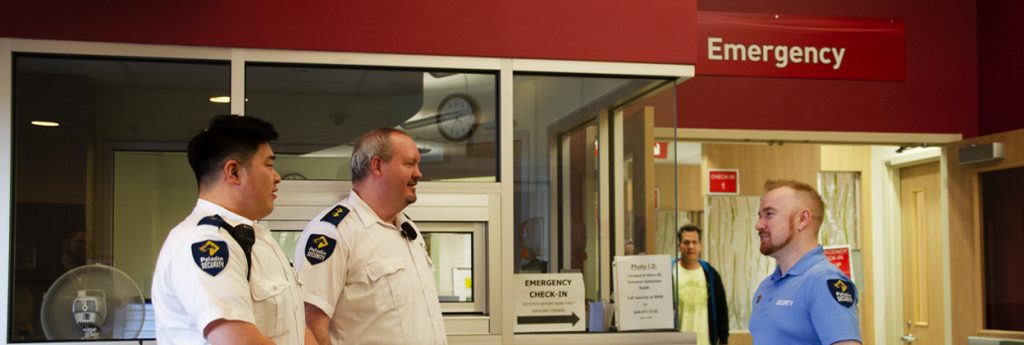


While it may seem obvious to those working in the healthcare security profession, how often have we heard people ask, why would you need security in a hospital? For those in the industry, debate centres more on how many security staff are needed and their functions in these complex and dynamic settings. In the spirit of David Letterman, we’ve compiled the top 10 reasons to have a healthcare security program.
Top 10 Reasons for a Healthcare Security Program
#10: Provide a Variety of Supporting Services
Whether it’s managing parking, lost and found, performing morgue support duties, dealing with patient valuables, cash transfers or acting as the point of contact for photo id/electronic access cards or keys, security is often the one stop shop for these and other activities.
#9: Liaise with Law Enforcement
Depending on the organization, this one sometimes moves up the list, but it’s important to every organization. Security staff members play a key role in helping police navigate the complex world of healthcare. Every health organization relies on their relationship with police to ensure a timely and appropriate response to criminal events on the property. But beyond that, security needs to link with correctional agencies as well, who bring often high-risk patient/prisoners to the facility for treatment. Security take a leadership role in communicating with clinical staff and helping mitigate the risk associated with these visits.
#8: Monitor / Operate Security Systems
As more and more security technology become an everyday part of a secure healthcare environment, security is front and centre monitoring alarms, electronic access control systems and often cameras, infant protection systems, and using the related software for dispatching an appropriate response for investigations.
#7: Deter Illicit Activity
This could fit in the “security culture” bucket but really speaks to the notion that an active, visible, uniformed security presence contributes to the perception of a healthcare facility as a harder target than those with illicit intent want to challenge.
#6: Create Culture of Safety / Security
Security management and front-line security staff must lead this lofty goal. Helping everyone who works there be the eyes and ears for safety/security by challenging and/or reporting suspicious persons and actions. Security staff reinforce this through teaching moments when vulnerabilities created through leaving doors unlocked or valuables unattended and providing security awareness education.
#5: Conduct Situational Risk Assessments
This means simply having security being able to think on their feet when a hazard or vulnerability is identified and implement an appropriate solution. A door won’t lock, a prisoner escort is not paying attention to his/her prisoner, a patient family member is showing signs of escalating aggression and a myriad of other healthcare situations – security needs to be able to assess and respond appropriately.
#4: Control Access
This has a lot of moving parts to it but, in its simplest form really means security must help create an access control plan, through design and monitoring, that helps ensure people on the property have a legitimate reason to be there and that internally, staff, patients and visitors do not enter areas where they are not authorized. Electronic security has a part to play here but, as importantly is the dynamic security piece around challenging unauthorized persons and legitimizing their presence.
#3: Provide Customer Service
Some organizations would have this as #1 and it would be difficult to argue. As ambassadors for the hospital, security has an opportunity to create a lasting, positive impression on patients and their families in the confusing and stressful healthcare settings. Kind words, going the extra mile, empathy – should all be part of the security staff mantra. Wayfinding is an important component of this aspect of the role but good customer service in all parts of the security function is critical.
#2: Respond to Emergencies
In every era of the evolving security profession, the involvement of security in responding to emergency events has been cited as a driving reason for having security. With a role to play in almost every emergency code/event, be it fire, chemical spill, evacuation, a mass casualty event impacting the hospital, a bomb threat, missing patient or other emergency impacting the facility, security always plays a key, and often lead role in response.
#1: Prevention & Management of Aggressive Behaviour
While this critical security function could live with the other emergency response functions in #2, the fact is that healthcare violence stands alone as the single biggest factor for having security in a healthcare facility. Security may conservatively spend two thirds of their time in an ED or Behavioural Health Unit helping clinicians manage patient aggression. While the ability of security to respond quickly to notifications of violence or potential violence is vitally important, at least as important is the role security can plan in defusing potential aggressive behaviour through their trained presence.
We may have missed some aspects of the security role, however, few can argue with these 10 reasons for security in a healthcare facility!
Are you interested in building a career in healthcare? Apply today: paladinsecurity.com/careers